
The Hunger Games took the 2010s by storm, cementing itself as a cultural phenomenon and one of the most recognizable cinematic franchises, garnering love and affection across generations and around the globe. Now, over a decade and one prequel later, the iconic series returns with The Hunger Games: Sunrise on the Reaping. And while it is by no means perfect, with plenty of evident flaws, it somehow remains just about captivating enough to potentially boast the same weighty cultural impact as those that came before it.
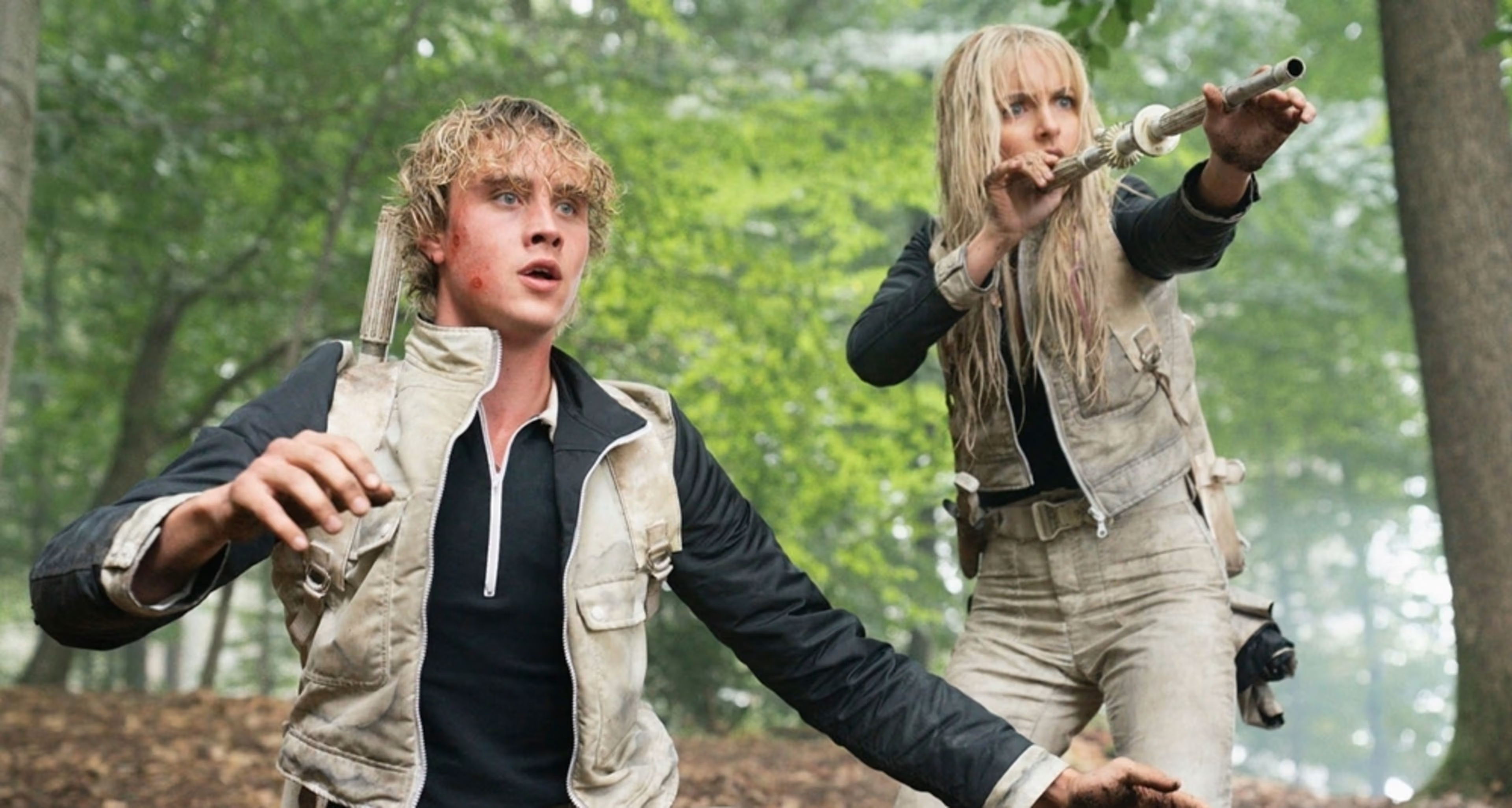
Set 24 years before the original film, Sunrise on the Reaping tells the story of a young Haymitch Abernathy (Joseph Zada) as he is selected as one of District 12’s tributes to compete in the 50th Hunger Games, also known as the Second Quarter Quell. With twice the usual number of contestants thrown into the arena, Haymitch faces what promises to be the most brutal Games yet, designed to reinforce the Capitol’s stranglehold on the districts. Amid the cruelty and chaos, he must not only fight for survival against his fellow tributes but also navigate the political machinations of a corrupt Capitol, forming unexpected alliances that threaten to challenge the very system keeping the districts in line.
When audiences already know how a story ends before it even begins, writers Billy Ray and Michael Lesslie, adapting Suzanne Collins’ novel of the same name, were always going to have to be creative in ensuring viewers remained fully invested in Haymitch’s journey. And for the most part, they are remarkably successful. Audiences are familiar with Haymitch as a cynical and abrasive drunkard, but what Ray and Lesslie’s screenplay manages to do is provide some genuinely pertinent insight into the harrowing circumstances he has endured, not just during the Games but in their aftermath too. It charts the transformation of a young man capable of such love and affection into the cruel, bitter, and hateful character most of us have come to know.
That’s all while tying in some of the most notable figures the franchise has to offer. Audiences are already familiar with the deep discontentment that characters like Plutarch Heavensbee (Jesse Plemons), Beetee (Kelvin Harrison Jr.), and Wiress (Maya Hawke) harbor toward the Capitol through their actions in previous installments. So attempting to tie all of that together in a prequel set 24 years earlier was always going to be a difficult task. However, in that regard, the writing is nothing short of terrific.
Many of the moments we get with these characters may feel a little too fleeting for some people’s liking, but through some exceptionally sharp dialogue, you’re able to gain a profound understanding of the resentment toward the oppression that even past victors continue to face at the hands of the Capitol. It’s fascinating to see how a small ember of defiance begins to ignite during these Games and how the formidable alliance we have seen operate in previous movies starts to take shape, with Haymitch essentially serving as Sunrise on the Reaping’s own Mockingjay of sorts.
All of the plotting, deception, and backstabbing before the Games have even threatened to begin provide some of the movie’s most enjoyable sequences. That’s particularly evident in the engrossing mental chess match between Plutarch Heavensbee and President Snow (Ralph Fiennes), who are playing against each other without ever truly realizing it. Watching these moves and subsequent countermoves unfold is utterly compelling, despite the twisted nature of some of their actions, particularly those of Heavensbee as he uses the tributes as pawns to ensure he can eventually land the killer blow. It is admittedly a slow and methodical buildup to the competition itself, but returning director Francis Lawrence has demonstrated previously, and does so again here, that these moments are crucial and often among the most impactful of the entire movie.
The Games themselves, though, prove to be a turning point, and unfortunately, for the most part, not for the right reasons. The Second Quarter Quell has long been known to fans of The Hunger Games as the most savage event in its history. However, after waiting so long and being on the edge of your seat in anticipation of some carnage, especially during the initial bloodbath, you can’t help but feel massively disappointed by how almost entirely devoid of action the proceedings are. In fact, on the first day alone, nearly half of the 48 tributes perish, yet you see virtually none of it.
And that’s unfortunately not something that ever really changes. Of course, the PG-13 rating makes the film accessible to a wider audience and is probably the right decision, but it does detract from the sheer ferocity you would expect these scenes to possess. In fact, we have previously witnessed far bloodier and more harrowing ends for tributes, particularly in the first Hunger Games movie, than anything that is even remotely threatened here.
And that’s before even mentioning perhaps the most disappointing element of all, which is the CGI. Several of the biggest deaths, which should be among the most devastating moments of the story, are completely let down by the shoddily rendered digital animals. On the one hand, they make it difficult to decipher what on earth is happening, while on the other, they look outright horrible. As a result, any tension or emotion you may have been feeling is immediately undermined, with the sheer artificiality of it all completely pulling you out of the immersion of the arena.
That’s not to say the visuals are poor throughout. In fact, it’s quite the opposite, which makes these shortcomings all the more baffling. When audiences are first transported into the arena, it’s almost mind-blowing just how beautifully realized it is, with its vibrant colors, immense scale, and breathtaking design, all complemented by a spectacular Cornucopia standing proudly at its center as the cherry on top. That’s coupled with some impeccable, sweeping, and at times kinetic camerawork that delivers genuinely awe-inspiring shots that will live long in the memory.
But perhaps the biggest disappointment of all in Sunrise on the Reaping is the numerous emotional swings it takes without ever truly landing any of them. It feels as though the filmmakers are trying desperately to recapture that unforgettable moment between Katniss Everdeen and Rue earlier in the franchise, one that moved so many to floods of tears. Yet here, while these sequences do provide a greater understanding of Haymitch’s character arc, none of the supporting players are developed sufficiently or afforded enough screen time for their inevitable deaths to resonate in the way they should. Instead, you’re left feeling rather hollow, with none of their losses leaving much of a lasting impression, which is certainly not something you would expect from a series that has previously handled such tragedy so effectively.

None of that blame, though, lands at Joseph Zada’s door, who is outstanding as Haymitch. The movie rests almost entirely on his shoulders, and had his performance not been at the level it is, it could have spelled absolute disaster for the entire production. Even if those ambitious attempts at pulling on the heartstrings don’t work as well as they should, the only reason they remain remotely believable is because of the raw emotion Zada is able to convey on screen. There’s a genuine sense of empathy in his portrayal that translates exceptionally well, elevating the material he’s given to the highest level possible.
The Hunger Games: Sunrise on the Reaping does manage to redeem itself somewhat in its final act, which is masterfully woven together to provide invaluable context not just for Haymitch’s journey, but also for those of several other key characters from the franchise. It’s in these moments that the emotional investment audiences are expected to have finally bears fruit, tying together so much of the series’ lore in one neat little bow that is bound to leave longtime fans immensely satisfied.
With so much history to explore, though, and such an extensive ensemble squeezed into a movie of this magnitude, it was always going to be difficult for anyone outside of Zada to truly stand out with the limited screen time on offer. That said, Jesse Plemons is a real highlight, with his cool and calculated mannerisms reminiscent of those we saw from the late, great Philip Seymour Hoffman. Kieran Culkin, as a young Caesar Flickerman, possesses an unmatched pizzazz and charisma, bringing some wonderfully dark comedic relief to the proceedings. But it’s arguably Glenn Close as Drusilla who steals the show, delivering a deliciously over-the-top and outrageous performance while possessing the kind of sinister disdain you’d expect from someone within the Capitol, enough to send shivers down your spine.
Unfortunately, though, the lack of screen time also makes even some of the biggest names feel rather forgettable. Most notably, Ralph Fiennes falls into this category, with his performance feeling like something of a missed opportunity. He is vastly underused and never really gets the chance to convey the imperiousness that makes President Snow such an intimidating presence. McKenna Grace, as Maysilee Donner, a fellow District 12 tribute alongside Haymitch, has been at the forefront of much of the marketing, yet is conspicuously absent for large portions of the story. Perhaps the most baffling inclusion, however, is Maya Hawke, who utters no more than two lines throughout the entire movie.
It would be fair to say that The Hunger Games: Sunrise on the Reaping is something of a mixed bag. When it’s good, it reaches genuinely phenomenal heights, and what is perhaps most frustrating is that its strengths indisputably outweigh its weaknesses by a considerable margin. But the flaws within the Games themselves simply cannot be ignored, leaving you with an overwhelming sense of what could have been. Because had they gotten those sequences right, Sunrise on the Reaping had every chance of becoming the crowning jewel of The Hunger Games franchise.