
There aren’t many movies in recent memory with a plot as farfetched as Brian Duffield’s latest, Whalefall. So it came as no surprise that when the first trailer was released, it took the world by storm. But what could’ve ended up being just another gimmicky horror flick looking to make a quick buck actually offers something far more layered and profound, while also cementing lead actor Austin Abrams as a certified scream king of the future.
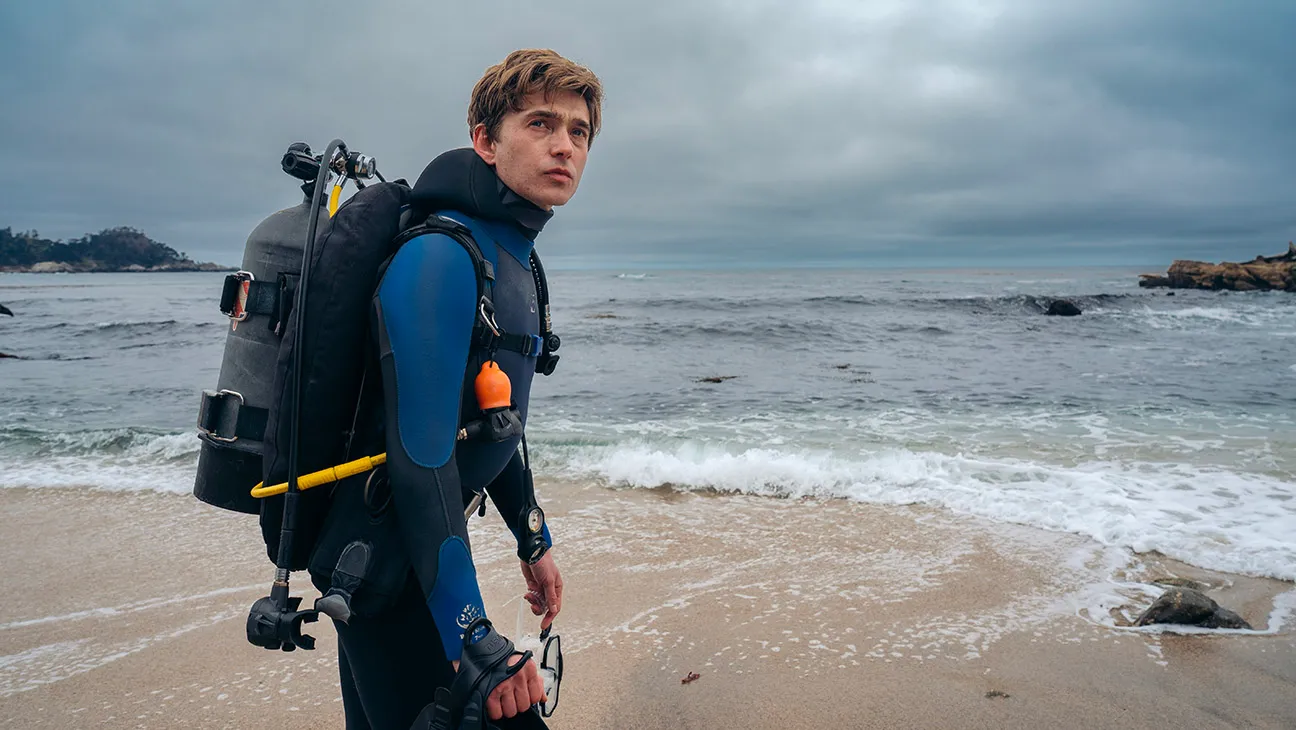
On the first anniversary of his father Mitt’s (Josh Brolin) suicide, Jay (Austin Abrams) returns to his small hometown to be with his family. He’s still trying to come to terms with the complicated emotions stirred up by his father’s death, having shared a difficult relationship with him for much of his life. Mitt had always attempted to “toughen up” his only son out of love, but it was an approach Jay had never been able to deal with, ultimately causing him to leave town for college. Now back home and struggling to navigate his unresolved feelings, Jay sets off on a solo mission to locate his father’s body at the bottom of the ocean in the hope of finding the closure he desperately needs.
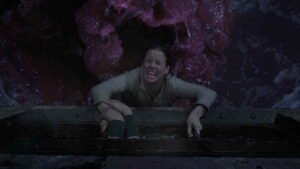
However, things don’t go as planned, as only a few minutes into his dive, Jay is swallowed whole by a giant sperm whale. What started off as a mission of retrieval now becomes a fight for survival, with his oxygen rapidly running out as he attempts to navigate the insides of the creature and find a way to escape. But while trapped inside its stomach, he begins to realize that the tough lessons his dad had tried to impart on him might actually hold the key to his survival, all while being forced to confront the lingering emotions surrounding their strained relationship.
While predominantly a survival thriller with a good dose of horror thrown in for good measure, Whalefall has a surprising amount of heart and emotion at its core. Although we spend the majority of the runtime watching Jay fight for his life, a series of flashbacks offer audiences a glimpse into the turbulent relationship he shared with Mitt. These moments provide some much-needed backstory and a greater understanding of their strained dynamic, one that I’m sure many fathers and sons will be able to relate to.
Those flashbacks become more frequent as the movie progresses, but that doesn’t detract from the tension that Duffield so carefully builds. Instead, as we gain a better understanding of these two individuals and the struggles that shaped their relationship, we become increasingly invested in their story. This certainly helps with the bigger emotional swings the script attempts as it heads toward the finish line. Surprisingly enough, while those moments might not hit quite as hard as intended, the movie still manages to tie together its exploration of the father-son bond and the painful realities of grief and loss in a way that will leave many satisfied.
Admittedly, even with a premise as farfetched as the one Duffield and fellow writer Daniel Kraus, whose book the movie is based on, have to work with, the final act perhaps takes things a little too far, veering into the preposterous and over-the-top as it desperately tries to make those emotional punches land. It does become somewhat distracting, and while you can understand why certain creative choices have been made, they ultimately prevent the exploration of bereavement and the process of coming to terms with it from resonating quite as strongly as it could have.
That said, predominantly through the flashbacks involving Josh Brolin and Austin Abrams, the script does offer some genuinely poignant messaging about the ocean’s ecosystem. It never comes across as overly preachy, which is to its credit, instead giving audiences a different perspective on just how fragile nature’s balance can be in an environment that humans still know relatively little about. It ensures that as the credits roll, you’re left with a greater appreciation for why this delicate harmony needs to be preserved at all costs.
The blend of flashbacks and Jay’s fight for survival works so well because of how smoothly everything is edited together. Editor Pietro Scalia ensures that the transitions between these two vastly different timelines and circumstances feel as seamless as possible. It was fundamental that Scalia got this balance right, as any missteps could’ve derailed the intensity and anxiety that the story had worked so hard to establish. Thankfully, he more than meets the mark, ensuring that the momentum never really feels compromised.
Of course, first and foremost, Whalefall sets out to be an adrenaline-fueled survival epic. So while its attempts to offer something beyond that might not be what some audience members come for, it still, for the most part, delivers on that promise. Throughout the time we spend inside the whale’s stomach, there’s an unsettling, claustrophobic atmosphere that successfully captures the sheer horror of Jay’s predicament. And with the numerous curveballs the movie throws our way, it’s bound to keep the vast majority of viewers on the edge of their seats.
Undoubtedly, the biggest highlight is yet another stellar performance from Austin Abrams. Fresh off the back of his impeccable turn in Resident Evil, he is tasked with carrying almost the entire weight of the movie’s success on his shoulders. For large stretches, that doesn’t even involve the use of dialogue, which makes his work all the more remarkable. The anguish conveyed through his facial expressions, alongside the agonizing cries and sounds of distress he’s able to produce, is nothing short of brilliant. It’s a portrayal that firmly establishes him as one of the most promising emerging talents within the horror genre, with three outstanding performances in the space of just a year.
One of the most striking aspects of Whalefall is its sound design. From fairly early on, it becomes one of the main focal points, with the piercing, eerie calls of the whale sending shivers down your spine as you remain unaware of what might be lurking in the murky depths of the ocean. It’s an element that continues to take center stage throughout the runtime, with one particular scene in the final act bound to have audiences wincing and squirming in their chairs. The audio masterfully complements what is unfolding before your eyes, making an already uncomfortable sequence all the more excruciating.
Visually, for the most part, the movie is also an extremely impressive feat. There’s not a single moment where the whale itself looks anything other than real, which is a remarkable achievement that makes the entire experience feel as immersive as possible. Admittedly, the lighting isn’t necessarily the best. It’s somewhat understandable, given that we spend much of the runtime either in the dark depths of the ocean or inside a whale’s stomach, but there are instances where it becomes difficult to make out exactly what is happening. However, cinematographer Aaron Morton does his best to combat this with some inventive shot selections and close-ups that are particularly effective.
While Whalefall might not be everything it initially appears to be on the surface, it has more than enough survival thriller elements to keep audiences thoroughly entertained. The emotional beats, even if they don’t land as heavily as intended, still serve a worthwhile purpose and provide a welcome change of pace, while offering an alternative perspective on grief, loss, and the father-son dynamic that is so precious to many. With all of that combined, it’s really hard not to have a whale of a time with Whalefall.