
Reviews
The Housemaid
Book to movie adaptations have become noticeably lower in quality in recent years, particularly with the rise of so-called spicy romance novels such as Colleen Hoover’s work or, to some extent, the Fifty Shades series. That said, I would be lying if I did not admit I was intrigued by The Housemaid despite that recent track record. Bolstered by a well known cast and a director in Paul Feig whose previous work I have enjoyed, I went in with relatively high hopes for an adaptation of this modern cult favourite. Sadly, the finished product leaves a lot to be desired.
I will be completely transparent. While I am aware of the Housemaid book series, I have not had the time to read even the initial novel on which this film is based. As a result, some of my criticisms may tread familiar ground or even mirror grievances already levelled at the books themselves. That would not be especially surprising, given that the film was co-written for the screen by the author Freida McFadden. Consider this your warning to take some of my points with a pinch of salt if you are a fan of the source material. As a standalone adaptation, however, there are several glaring flaws that simply cannot be overlooked.
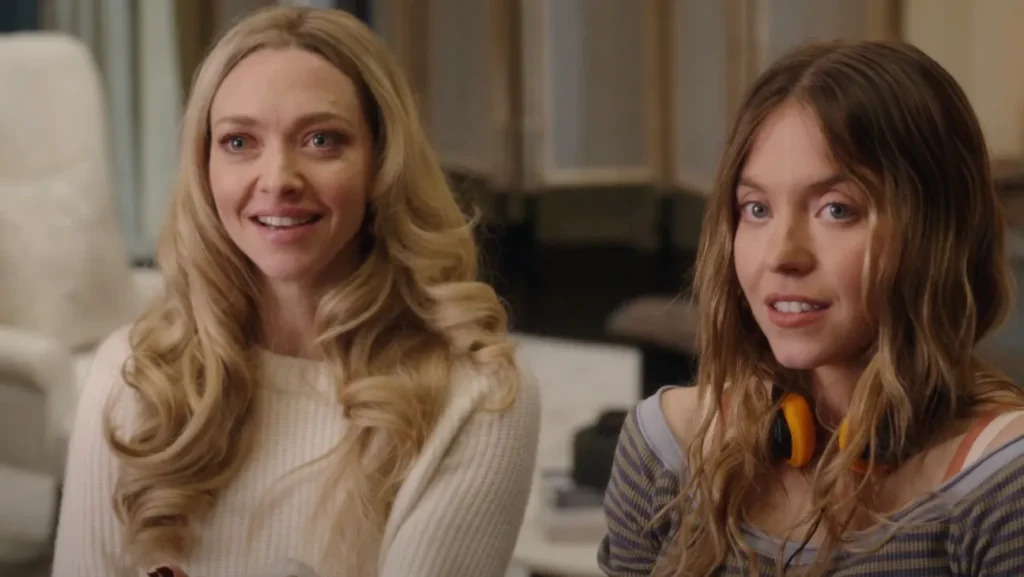
The story itself is a simple one, but I will keep it deliberately vague, as going in blind is possibly the best way to experience it. The film follows Millie (Sydney Sweeney), a struggling woman attempting to restart her life following what we will loosely call unfortunate circumstances. There is, however, light at the end of the tunnel for Millie and her somewhat questionable CV, as wealthy and uptight housewife Nina (Amanda Seyfried) offers her a position as a live-in nanny for her daughter Cecilia (Indiana Elle).
The decision to hire Millie comes as a complete surprise to Nina’s husband and Cecilia’s stepfather Andrew (Brandon Sklenar). He is presented as a meticulous individual who clearly harbours unresolved issues stemming from his overprotective mother Evelyn (Elizabeth Perkins). Yet instead of carrying out even the most basic research into the stranger who is about to live in his home, he simply goes along with it. This marks the first in a long line of baffling narrative choices that would have ensured none of what follows would have happened in the first place. What makes this particularly frustrating is that a great deal of time is spent establishing Andrew’s obsessive nature and need for control, traits that would almost certainly have driven him to at least perform the bare minimum of background checking on this new arrival in his carefully curated home. But I digress.
Naturally, a new presence in the household brings with it drama, which the groundskeeper Enzo (Michele Morrone) briefly attempts to prevent in his near mute way, before being reduced to little more than a spare part in the grand scheme of things. That tension gives rise to an endless stream of twists and turns, each more predictable than the last. I will leave those to be discovered firsthand. However, with each new reveal comes an increasing number of glaring and painfully obvious plot holes, so apparent that it becomes difficult to understand how they were either not noticed or, more likely, simply ignored.

Why does the parole office never check in after multiple missed meetings? Why does Enzo’s sole piece of character development get completely nullified? Why does Andrew’s mother, despite being a fundamental part of the story for large stretches, essentially vanish without explanation? Each of these issues is irritating in its own right, but none come close to the farcical ending, which was so absurd that I could not help but laugh.
While many of the film’s problems undoubtedly stem from its shoddy script, the performances of Brandon Sklenar and, in particular, Sydney Sweeney leave a great deal to be desired. Serious questions now have to be asked of Sweeney in yet another leading role in which she fails to meet the mark. Her work is fairly wooden throughout and is made to look even weaker by Amanda Seyfried, who manages to elevate the mediocre material to an entirely different level. It is a standard Sweeney never comes close to reaching. Had her performance matched that of her counterpart, the overall experience might have been vastly improved. Instead, much like the final product itself, her contribution feels below par.
Sklenar, on the other hand, feels completely miscast. There are moments where his character is meant to exude charm and charisma, yet neither quality ever truly comes through. Likewise, in scenes that call for intensity or genuine menace, his portrayal falls flat. This is, of course, only my interpretation of the material as presented in the screenplay, but I found myself expecting a level of intensity closer to that of someone like James McAvoy. What we are given instead is something far more muted, and ultimately ineffective.
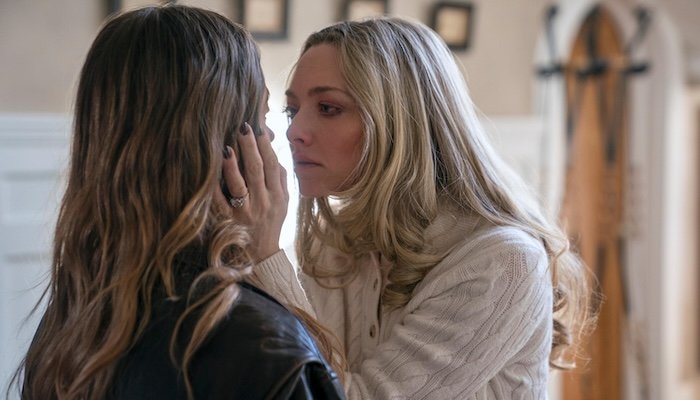
I am aware this may come across as harsh, but when the film is stripped back to its bare bones, there is clearly an interesting concept at its core. There are genuine glimpses of quality throughout, which makes it easy to believe the novel itself is far stronger. Unfortunately, translating that magic from page to screen proves to be a step too far. Much like a lot of director Paul Feig’s recent output, the theatrical version of The Housemaid is ultimately underwhelming.
The stakes and thrills feel as though they should be sky high given the nature of the source material, yet I would be lying if I said it ever truly captured the edge of the seat anxiety I craved from a film like this. While I hope fans of the book find something to enjoy here, for me this goes down as another below par book to movie adaptation, offering an experience all too similar to Regretting You earlier this year.