Reviews
good luck, have fun, don't die
Almost a decade after his last feature film, director Gore Verbinski is back. If you’re at all like me, this return feels long overdue. There are very few filmmakers that I’ve grown up with who have such a distinctive voice, and it’s one that has been sorely missed, especially in times like these. So what better way to re-enter the global spotlight than with a science-fiction comedy that grapples with contemporary anxieties around artificial intelligence? With the quirkily titled Good Luck, Have Fun, Don’t Die, that’s exactly what Verbinski does, and he returns with a bang.
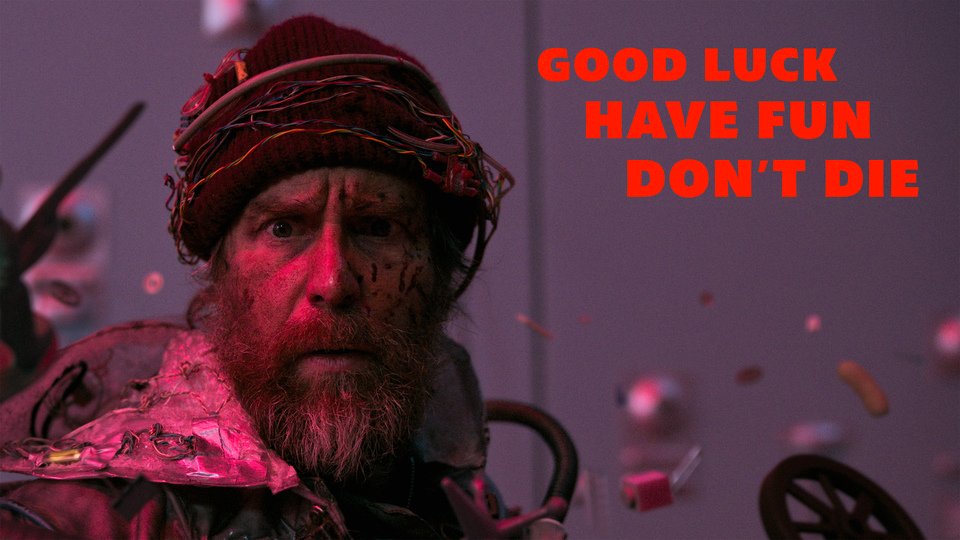
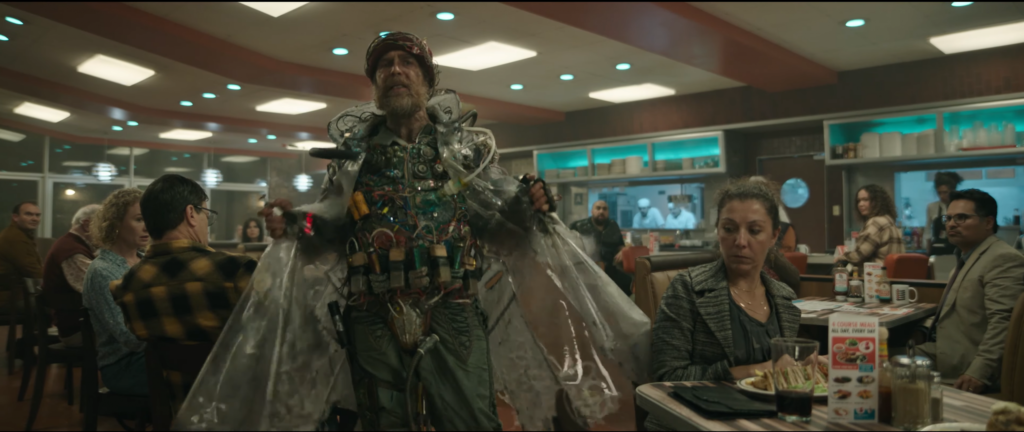
The premise of the movie, written by Matthew Robinson, is, on the surface, quite simple. A “man from the future” (Sam Rockwell) bursts into Norm’s, a late-night Los Angeles diner, warning of an impending doom caused by a rogue artificial intelligence that is on the brink of wiping out humanity. Presenting himself as both a messenger and potential saviour, he claims the only way to stop the apocalypse is to gather the right combination of “heroes,” or to you and me, “sacrifices,” for a suicide mission to prevent the AI from ever being created. The biggest challenge is finding the right group. As the film’s brilliant opening monologue makes clear, this isn’t the first rodeo, in fact, far from it. We’re now into the hundreds, with Rockwell’s character hilariously recounting tales of previous doomed recruits.
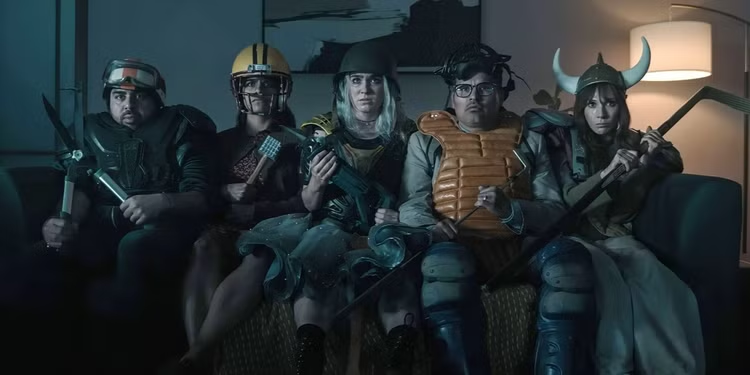
Armed with a USB stick and blind optimism, his latest team consists of a mysterious princess cosplayer, Ingrid (Haley Lu Richardson); troubled lovers and teachers Mark (Michael Peña) and Janet (Zazie Beetz); grieving mother Susan (Juno Temple); and several others who function more as cannon fodder than meaningful contributors to the narrative. This ragtag group, a kind of basement-level Avengers, must navigate a series of escalating twists and turns to reach a nine-year-old boy’s house, the catalyst who is about to unleash the AI that ends the world.
Within this premise sit three deliberately on-the-nose, yet deeply pertinent lessons that feel especially resonant in the current moment. These ideas are explored through loosely anthological segments that give the film space to focus on the individual stories of the characters making up the group, and the paths that led each of them to Norm’s diner that night. This structure allows the audience to gain an attachment to the characters, bringing a more recognisable human experience to the wacky science-fiction narrative the film first promised.
You would be forgiven for thinking that some of the most pointed social commentary on the big screen would not come from a science-fiction comedy. Even writing this now, I am still surprised at just how direct Good Luck, Have Fun, Don’t Die truly is. Robinson and Verbinski have the minerals to say what so many others have avoided, and they do so with confidence.
This ranges from confronting the subject of school shootings and the way the American public has become disturbingly desensitised to one of the most heinous crimes imaginable, while meaningful action remains notably absent, to examining how society has become lost in technology and social media, increasingly disconnected from the world around us through endless screen time. The movie also acknowledges that artificial intelligence is no longer a distant threat but an inevitability, and that the real question lies in how humanity chooses to harness that power for good rather than be consumed by it. We find ourselves at a pivotal moment, almost like we’re on a see-saw, where the choices we make now will determine whether the future bends toward progress or collapse.
To its absolute credit, even while tackling subject matter of this nature, Good Luck, Have Fun, Don’t Die never feels as though it is pandering to its audience, nor does it collapse into the easy and overused argument that “AI is bad.” Instead, the film embraces a far more nuanced approach, both in its narrative and in its execution. It is difficult to imagine anyone leaving the cinema without finding something to relate to, whether that be in one story arc or several, as the film consistently challenges its characters and, by extension, its audience.
Good Luck, Have Fun, Don’t Die is further elevated by strong performances across the board. Zazie Beetz and Michael Peña work convincingly together as an on-screen couple, while Haley Lu Richardson, given significant screen time, rises to the challenge of a well-written and engaging character. But without a doubt, it’s Sam Rockwell and Juno Temple who ultimately steal the show. Temple brings a level of emotion and humanity that’s unmatched, creating moments of genuine emotional poignancy that linger long after the film ends. Rockwell, meanwhile, delivers his best performance in years, reaching levels I haven’t seen since his Academy Award nomination. He perfectly embodies the chaotic energy of a wild, unpredictable man from the future and then pushes it even further.
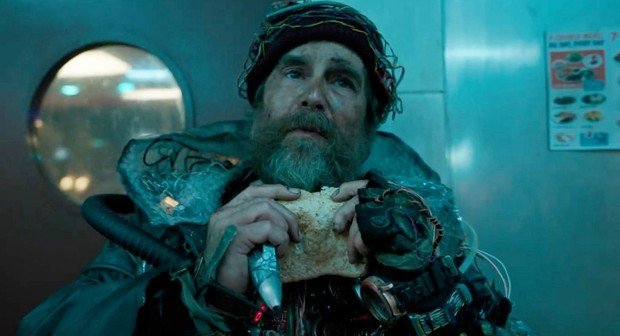
Visually, the film features several spectacular moments scattered throughout, particularly in the final act, which contains genuinely jaw-dropping sequences that light up the room. Cinematographer James Whitaker should be immensely proud of the work on display. The sound design by Geoff Zanelli is equally impressive, with the music in both the opening and closing acts standing out as some of the film’s strongest elements. That said, singling out individual contributors almost feels unfair, as the cast and crew collectively come together to create what is ultimately a wonderful and unexpected surprise.
While the film’s middle section is not quite as strong, meandering slightly in comparison to the rest and at times feeling a little bit like Ready Player One, this is ultimately a minor grievance in what is otherwise an extremely well-made, well-written, and well-acted film that will, in my opinion, age like a fine wine. My only hope is that enough people choose to support original projects like Good Luck, Have Fun, Don’t Die during its theatrical run, though it seems more likely that many will discover it later on streaming, an irony that feels particularly fitting given the film’s subject matter.