

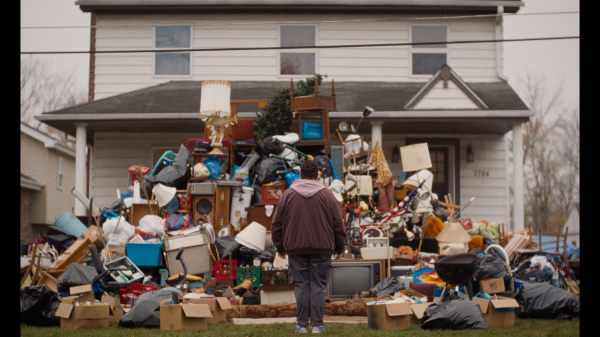
At first glance, it would be easy to dismiss Trash Mountain as just another formulaic dramedy. After all, it has many of the same ingredients and follows a similar plot structure to successful movies we’ve seen within the genre before. The key difference here, though, is star and co-writer Caleb Hearon, who seemingly brings some of his own personal experiences to the story, providing a level of heart and emotion that many similar films can only dream of conjuring up.
Directed by Kris Rey and co-written by Hearon and Ruby Caster, Trash Mountain follows Gavin (Hearon), a drag show host living in Chicago. There, he’s able to express himself freely, has a close-knit community and support network that embrace him for who he is, and can be open about his sexuality. That picture-perfect life is abruptly interrupted by a call from his half-sister Abbi (Zooey Deschanel), letting him know that their father has passed away.
Gavin is forced to return to his hometown in rural Missouri, where what he thought would be a quick trip to pay his respects turns into the logistical nightmare from hell. As it turns out, on top of being an alcoholic, his father was a reclusive hoarder who left behind a literal trash mountain. What Gavin imagined would be a brief visit to say goodbye instead becomes an extended stay in the very place he had always tried to escape. Now, he has to face challenges and grief that have seemingly been suppressed for years.
On the surface, the movie doesn’t seem too dissimilar from others within the genre, but that changes when you dive a little deeper into Hearon’s life and understand where he has personally come from. The fictional rural Missouri setting isn’t entirely removed from reality, as Hearon himself grew up in a similar community. That connection gives Gavin’s experiences an added sense of authenticity, particularly when it comes to the hostility he faces regarding his sexuality.
The narrow-minded townspeople provide plenty of comic relief throughout the story, but there’s also a sense that the humor is masking something much more painful. The screenplay directly takes aim at that conservative way of thinking, whether it be through the sheer number of guns found inside their hoarder dad’s home or the way the devout Christian faith of many members of the community shapes their opinions of Gavin’s choices. It feels informed by the type of prejudice someone in Gavin’s position could experience in a place he once called home, making the movie far more grounded and thought-provoking than its familiar setup initially suggests.
Hearon has made a name for himself through self-deprecating comedy, and Trash Mountain is no different. Whether it be his size, sexuality, or even his personality, Gavin is often the butt of jokes that hit time and time again throughout the runtime. But there’s an overwhelming feeling that he uses humor as his own unique defense mechanism, allowing him to avoid the unresolved trauma that is clearly eating away at him beneath the surface.
That continues through a large portion of the movie until the brother-sister dynamic that the story is crying out for finally takes center stage. It’s here where the performances of both Hearon and Deschanel are allowed to shine brightest. Their chemistry together is wonderful as they begin to recapture their childhood connection even in the most tragic of circumstances. Watching that relationship gradually rebuild is genuinely touching and gives the movie much of its emotional weight.
Hearon, as expected, is hilarious, but in his first leading performance, it’s the more dramatic elements of his work that prove the most captivating. Anyone familiar with Hearon will expect him to be funny, but the ease with which he switches things up and delivers the movie’s more emotional moments is particularly impressive and somewhat unexpected. It’s clear evidence that he has the tools at his disposal to take on much bigger parts going forward.

Deschanel recaptures the charm that made her a star in the first place, but there’s more going on with Abbi than that. She brings an air of vulnerability and fear to the character, all while Abbi is trying to hold everything together and be a mother to her own family. It’s the type of performance that makes you wish Deschanel appeared on the silver screen more often, as she clearly still has the talent to be a leading presence in a feature-length movie.
There are also some terrific supporting turns. Kyle Marvin, as Abbi’s husband, is the most prominent, and he makes the most of every second he has on screen. From the moment he’s first introduced to his last, he delivers some of the funniest one-liners in the movie. Jaboukie Young-White, as Jerome, Gavin’s love interest, provides a comforting presence that gives the story room to explore some of its more hard-hitting emotions. But it’s Jacki Weaver as Grandma Helen who threatens to steal the movie every time she appears.
While the way Trash Mountain unfolds will feel somewhat familiar, it’s the journey to get there that matters most. In that regard, the film delivers, leaving you with the kind of warm, fuzzy feeling that might just make you want to hug your family members a little tighter as the credits roll. Undoubtedly hilarious, with plenty of charm and heart to boot, Trash Mountain is one of the more surprisingly entertaining titles at this year’s Toronto International Film Festival.