
Reviews
Mercy
Sometimes you can watch a trailer for a movie and it looks dreadful, but then you go in and actually watch it and it completely blows your mind. The Iron Giant is probably the best example of this. However, if you’re expecting anything remotely similar with Mercy, I hate to break it to you, but prepare to be extremely disappointed, because the final product somehow ends up being even worse, which is surprising for all the wrong reasons.
The premise for Mercy is remarkably similar to Minority Report, although that’s where the comparison should end, as it doesn’t even exist in the same stratosphere quality wise. Mercy is set in the not too distant future of 2029, although the ugly dystopian look would certainly have you questioning that choice. America is in a state of crisis where crime has reached unprecedented levels, and in a bid to regain control, the mercy Court is introduced, where an AI judge acts as judge, jury, and executioner in murder trials. This, we’re told, is the only viable solution.

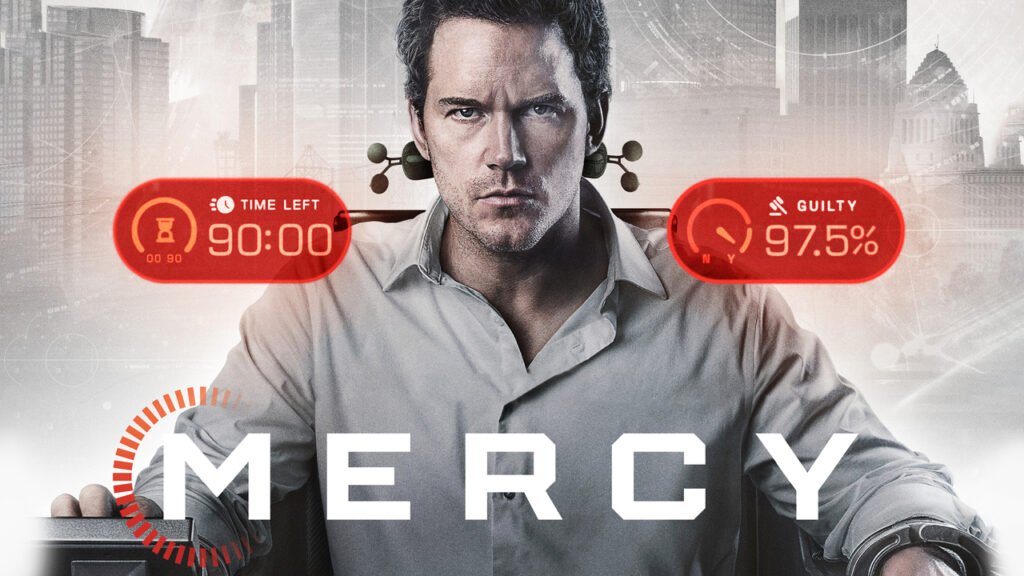
After opening with a massive exposition dump that brings the audience up to speed on the rules of the court and how the AI judge, Judge Maddox (Rebecca Ferguson), operates, we’re introduced to Detective Chris Raven (Chris Pratt). Except instead of solving crimes, he’s sitting in what I like to call the chair of doom, as he finds himself on trial for the murder of his wife. He now has 90 minutes to prove his innocence beyond reasonable doubt, which, if you’re paying attention to the exposition, means dropping below the 92 percent threshold. The problem for Raven is that before the trial has even really begun, his guilt level is already at 97.5 percent.
From there, the movie plays out in real time, which on paper is a fun concept, but in execution is where the cracks really start to show. There are multiple moments where characters quite literally teleport from place to place, which completely destroys the illusion of events unfolding naturally before your eyes. One particularly egregious example sees a group of characters scale a fully fledged skyscraper in roughly 30 seconds. Once that illusion is broken, it’s never really recovered, and unfortunately this happens very early on.
Fundamentally, the plot leans heavily into familiar tropes we’ve seen countless times before, never really doing anything interesting and taking the most predictable route available. Only a small number of meaningful characters or suspects are introduced, which means there’s no real mystery or tension building toward a reveal. Realistically, outside of Raven himself, they are the only people who could possibly be involved. The bigger issue is that none of them are remotely interesting to begin with, so by the time Mercy reaches its big moment, the overwhelming feeling is simply why should I care.

The writing by Marco van Belle, best known for the 2015 disaster Arthur & Merlin, is predictably bad. There’s some genuinely shameful pro-AI sentiment scattered throughout, particularly in the dialogue, with the line “We all make mistakes, human and AI, it’s about how we learn from them” standing out as one of the most toe curling and nauseating things I’ve heard in a long time. Even worse are the glaring plot holes that keep piling up. The film establishes that this AI judge supposedly knows everything, with all citizens forced onto a municipal cloud that allows total surveillance. Despite that, the number of insane oversights in Raven’s case, and others that become clear later on, pushes the film from ridiculous to almost laughable.
Mercy also repeatedly breaks its own rules, the same rules it seemed desperate to hammer into the audience within the first five minutes, suggesting a complete lack of trust in anyone’s critical thinking abilities. Judge Maddox is meant to be a completely neutral entity, yet this is almost immediately contradicted through smug dialogue, angry facial expressions I’d expect from my wife if I hadn’t washed the dishes, and direct interference in police activity. Any goodwill the film might have built is thrown straight out the window, making the entire premise feel pointless.
Despite being marketed as an IMAX 3D experience, the movie looks strangely janky, and the 3D itself is a complete gimmick. There isn’t a single scene that feels like it genuinely benefits from the format. A film like Mercy should be tense and anxiety inducing, yet I’ve felt more tension trying to remember whether it’s bin day than I did at any point during this runtime. That’s before even mentioning the cardinal sin of action scenes that are so painfully generic they somehow manage to be boring.
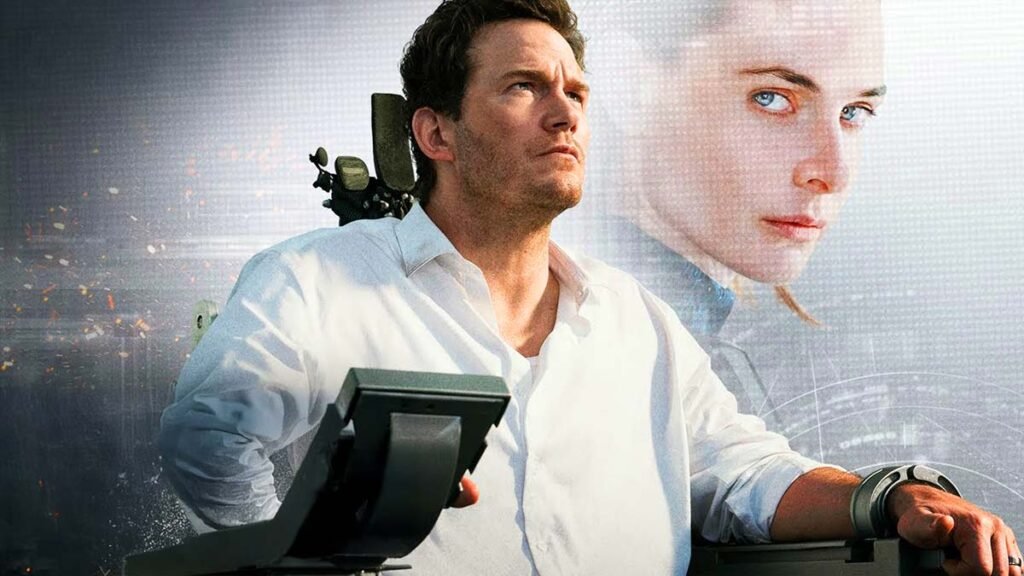
All of that is before even mentioning Chris Pratt’s performance. I’m usually a big Chris Pratt fan, ever since he found his way to my funny bone on Parks and Rec, but here he is painfully wooden. Phoning it in is the phrase that immediately comes to mind. While I can forgive some of that given the material, an actor of his calibre should still be able to elevate even weak writing to some degree, but it never feels like he even tries. The same can’t be said for Rebecca Ferguson, who at least appears to be making an effort, though the poor material ultimately dooms her performance to being completely forgettable.
By the time Mercy finally crawls to its conclusion, following a series of unnecessary and eye-rolling twists that push the film into levels of ridiculousness even the previous 90 minutes hadn’t reached, I felt nothing but relief. Relief that it was over, and hope that this would be the worst of what has otherwise been a surprisingly decent January for releases. Mercy is definitely a movie, but it’s not one anyone should be wasting their hard earned money on this weekend.