
Reviews
Blue Moon
Making a feature-length movie is hard. Making a good feature-length movie is extremely hard. But what about making one set entirely in a single location with almost the entire runtime consisting of a few conversations? How hard is that to pull off, and how hard is it to make it genuinely entertaining? Those are questions that Richard Linklater might be one of the few filmmakers alive capable of answering, as his latest film, Blue Moon, is exactly that.
Blue Moon is set over a single evening following the premiere of the now iconic musical Oklahoma! The movie centers on famed lyricist Lorenz Hart (Ethan Hawke), who for decades produced hit after hit with his composing partner Richard Rodgers (Andrew Scott). Oklahoma! marks the first time the pair have worked separately, with Rodgers turning to Oscar Hammerstein II (Simon Delaney) for lyrics. The film immediately establishes Hart’s struggles, including his battle with alcoholism.
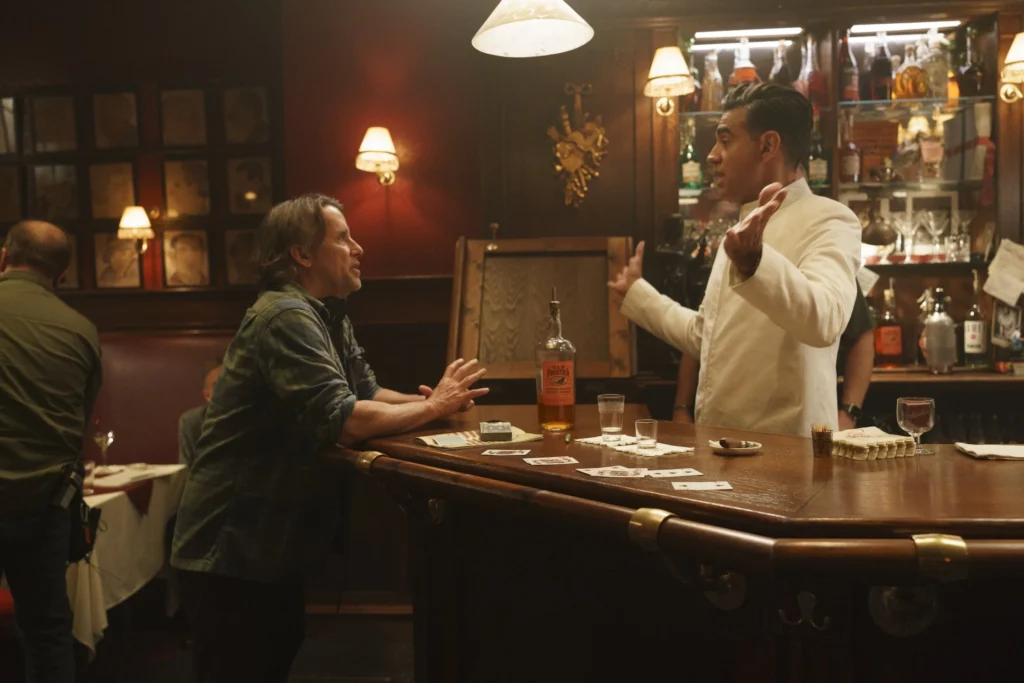
Aside from the opening scene, which shows Hart leaving the premiere early, Blue Moon takes place entirely in the bar Sardi’s, where the cast and crew hold an after-party. In this one location, the film explores Hart’s disappointment over the success of Rodgers’ work without him. Through conversations with bartender Eddie (Bobby Cannavale), Hart recounts past stories and expresses his passionate love for his young protege Elizabeth (Margaret Qualley). He also interacts with fellow attendee E.B. White (Patrick Kennedy), as they both regale each other with their shared passion for words and writing. Hart’s eccentricity dominates, shifting rapidly between humorous self-deprecation and confident assertions of his talent.
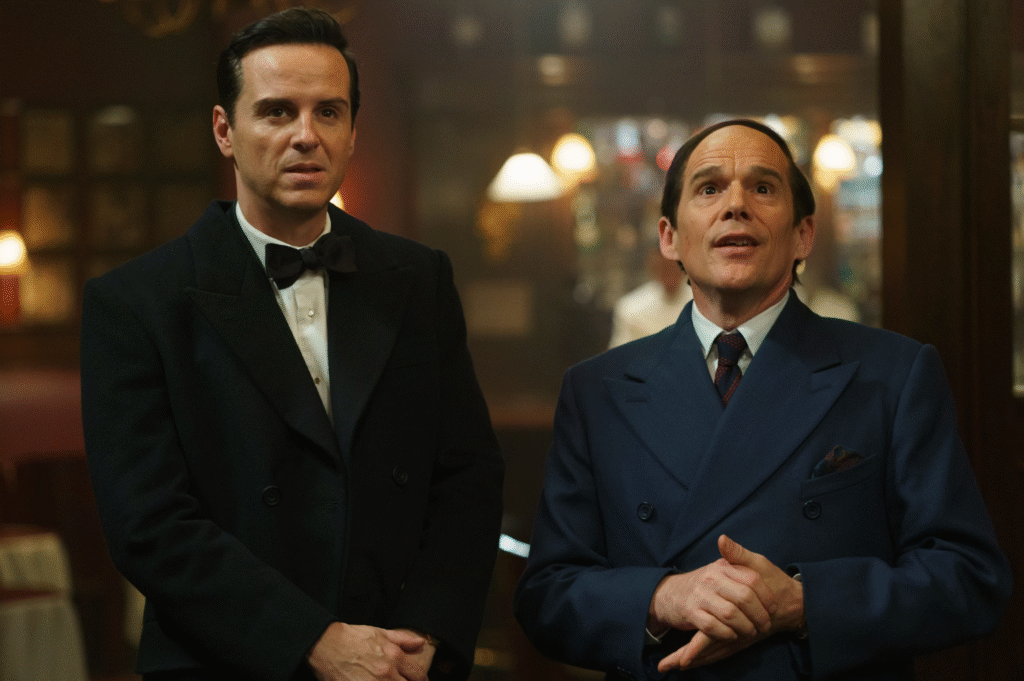
As the evening continues, more guests arrive, allowing for multiple exchanges between Hart and Rodgers that provide some of the film’s most compelling moments. Rodgers offers to collaborate again on a revival of one of their musicals, but Hart insists on creating something entirely new, highlighting his disdain and jealousy toward Rodgers and Hammerstein II. At the same time, the film shows Rodgers’ respect and admiration for Hart, despite his patience being tested. The contrast between Hart’s cynicism and Rodgers’ optimism, evident in his work and worldview, is stark, like two ships sailing away from each other in the night.
The final act is by far the most excruciating for the audience, as Lorenz and Elizabeth converse over a disappointing sexual encounter on her birthday. Despite Lorenz’s deep love for Elizabeth, a woman more than half his age, it becomes painfully clear that her feelings are closer to friendship than romance. The scene is raw, and watching Lorenz squirm and slump into the realisation that he may be completely alone is almost unbearable.
With a single-location film like this, it almost entirely succeeds or fails based on the script, and writer Robert Kaplow delivers exceptionally. Not a single line of dialogue feels wasted. From the very beginning, the conversation is fast-paced, evolving with the emotional ebbs and flows of the evening, and it’s impossible not to be drawn in by the intrigue and development between such compelling characters.
But as important as the script is, it is only as effective as the actors bringing it to life, and perhaps the most impressive aspect of Blue Moon is Ethan Hawke. Throughout his career, Hawke has shown remarkable range in his roles, but this may be his finest performance yet. His mannerisms, dialogue delivery, and comedic timing are impeccable. At this point, it would be hard to find five performances this year as accomplished, and he deserves recognition when award season comes around.
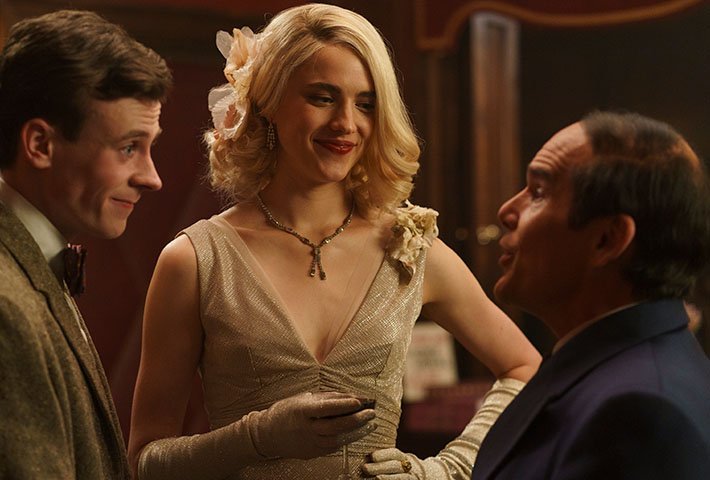
Andrew Scott as Rodgers and Margaret Qualley as Elizabeth, despite their comparatively limited screen time, are equally fantastic. Every second they appear on screen is fully realized, elevating each scene and perfectly playing off Hawke’s performance.
It’s abundantly clear that Blue Moon will not be for everyone. It is a simple, dialogue-heavy film, but it is precisely those conversations that deliver some of the best dialogue of the year, brimming with energy, humor, and heart. Captivating from the start, Blue Moon has secured its place as one of my most surprising films of the year and cements Linklater as one of my favorite working directors.